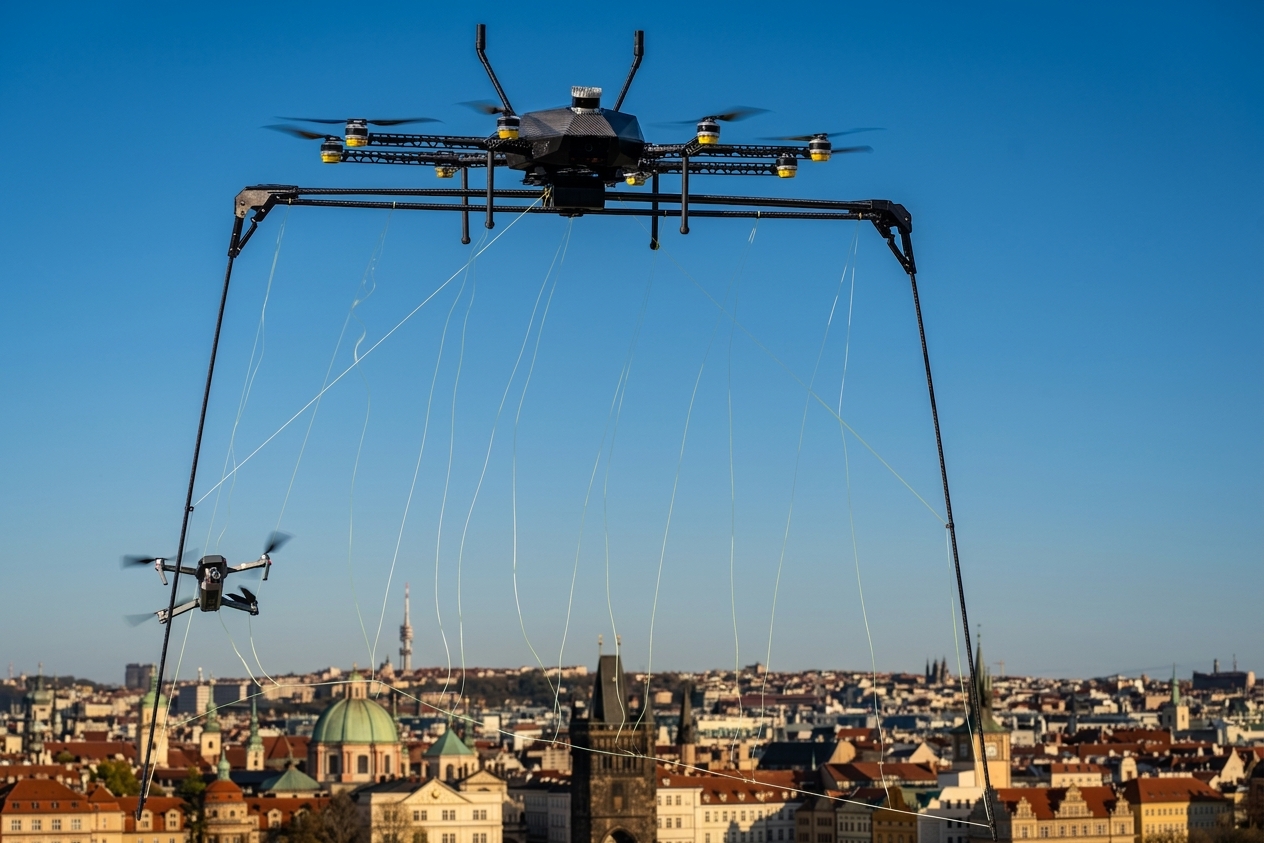
When people think about anti-drone operations, the instinct is simple. Stop the drone as quickly as possible.
That is only part of the job.
In real operations, the response matters just as much as the interception itself. A drone may be the immediate threat, but the way it is stopped can create a second one. In a city, near an airport, above a public event or around critical infrastructure, that second risk can be just as serious as the first.
A successful interception cannot be judged only by whether the drone was brought down. It must also be evaluated based on what happens afterward, where the drone falls, what it impacts and whether the response keeps people and property safe.
This is where collateral risk becomes critical.
Even when an attack is stopped, the danger does not automatically end. A drone falling from the sky can still injure people, damage vehicles, hit buildings, cut power lines or impact sensitive equipment. Aviation authorities treat drone incidents not only as airspace risks, but also as threats to people and property on the ground.
If the drone breaks apart during interception, the problem can become more severe. Instead of one object, multiple fragments may fall across a wider area with little predictability. Research and safety guidance consistently highlight this risk. Falling drones and their components can cause serious injury and material damage.
That is why stopping the drone alone is not a sufficient measure of success. In many cases, the real challenge is ending the incident in a controlled way. If the response results in debris falling over a populated area, one problem may be solved while another is created.
The risk increases further if the drone carries a payload. In such cases, the wreckage may include batteries, hazardous materials or explosive components. Even if the drone does not reach its intended target, what reaches the ground can still have serious consequences.
Low collateral risk is not an added benefit. It is a core requirement of responsible anti-drone operations.
Operators need more than a system that can stop a drone. They need a system with a predictable outcome. Will the drone fall freely. Will it remain intact. Will fragments scatter. Will the response create a new risk below. These questions are central to decision-making.
This is also where public trust plays a role. Anti-drone operations often take place in environments where the outcome is immediately visible. Most people will not know what method was used, but they will recognize whether the situation ended in a controlled manner or in chaos. If the response leads to damaged property or injured bystanders, trust is lost quickly.
As drone threats become more common, the standard for response must rise accordingly. It is no longer enough to ask whether a system can stop a drone. The more important question is whether it can do so without turning the airspace into a secondary source of danger.
Phone
Company
EAGLE.ONE s.r.o., ORG ID: 03947394
Povltavska 5/74, 171 00 Praha 7
