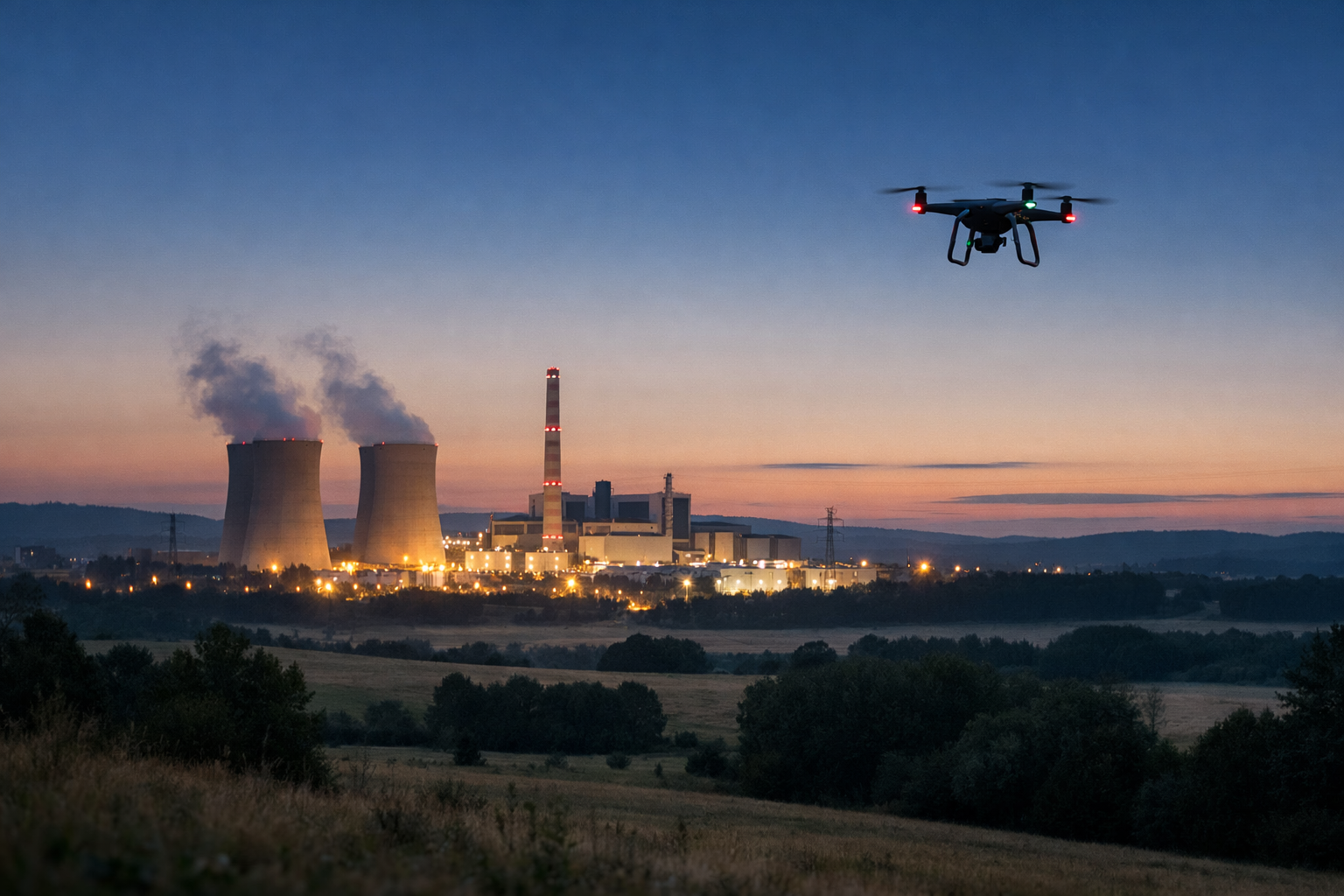
A modern power plant is built to withstand a lot for example weather, mechanical wear and even unexpected demand spikes. What it was not designed for is a new kind of vulnerability: small, cheap and difficult to notice from the ground.
Imagine a simple situation. It is evening. Operations are routine. The perimeter is secure in the traditional sense. Fences, cameras and access control are all in place. But above the fence line, the airspace remains quiet and largely unmonitored.
A small drone approaches. It is not a military platform. It could be commercially available. It flies low, blends into background noise and follows a path that avoids obvious sightlines. No one hears it. No one sees it. No alarm is triggered, because most security systems were never designed to treat the sky as an entry point.
The drone reaches a restricted area. What happens next depends on intent, payload and opportunity, but the underlying risk remains the same. An attacker does not need to take control of an entire power plant to cause serious damage. Disrupting a single critical component at the wrong moment may be enough.
In a power facility, even a minor incident can cascade. A short circuit. A damaged sensor. A fire in a sensitive zone. An automatic shutdown procedure. In the best case, the plant experiences a temporary disruption and operators recover quickly.
In the worst case, the impact spreads beyond the facility itself. Electricity supply becomes unstable. Industrial sites pause production. Traffic control systems degrade. Hospitals switch to backup power. Public confidence is shaken, and authorities begin asking an uncomfortable question. How did something so small get so far?
The most dangerous part of this scenario is not the drone itself. It is the gap in perception.
Many critical infrastructure sites still rely on security models that assume threats come from the ground. Drones change that assumption entirely. They move the problem into three dimensions. They are fast, low cost and increasingly capable. They can appear for minutes and disappear just as quickly. That makes early detection and response time critical.
This is why airspace security is becoming a core element of infrastructure resilience. Not to create panic, but to eliminate blind spots. The objective is straightforward: detect unauthorized drones early, track them reliably and respond in a controlled manner that prioritizes safety.
For modern facilities, the question is no longer whether such a scenario is possible. The more relevant question is whether it would be noticed in time.
EAGLE.ONE is built around this exact challenge. Autonomous detection and tracking, combined with a safe approach to neutralization, help critical sites protect what matters without relying on luck or perfect visibility.
Because when it comes to power generation and distribution, a single unnoticed drone should never be enough to trigger a crisis.
Phone
Company
EAGLE.ONE s.r.o., ORG ID: 03947394
Povltavska 5/74, 171 00 Praha 7
