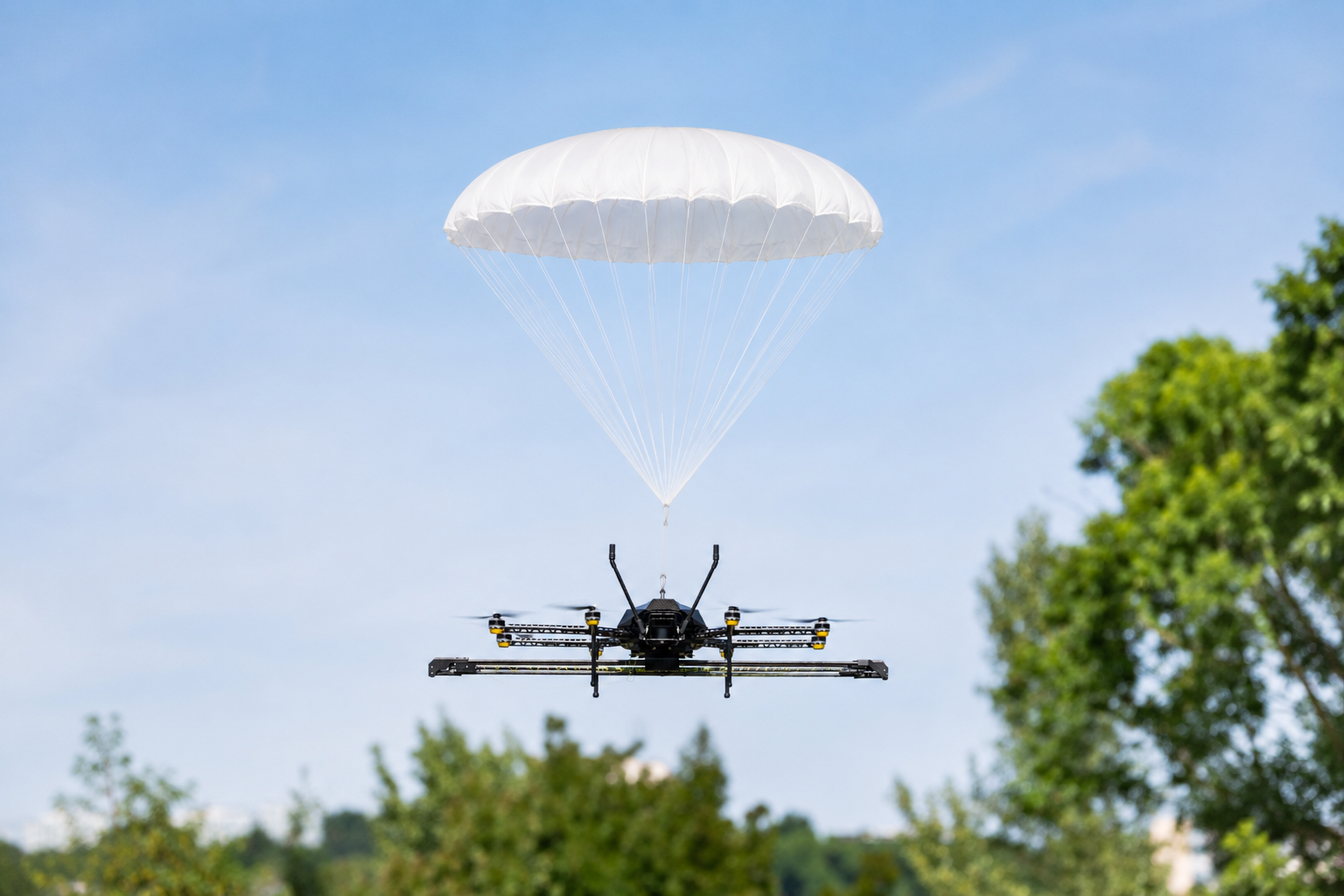
Safety in autonomous drone operations is not only about what happens when everything works. It is also about what happens when something fails.
Even a well tested drone can face unexpected situations. A component can stop working, weather can change, or the aircraft can lose stable flight. In that moment, the goal is simple: reduce the risk as much as possible.
If the drone starts falling uncontrollably, the parachute acts as a final safety layer. It slows the descent, makes the fall more predictable, and helps reduce the chance of unnecessary damage on the ground.
This is especially important in sensitive environments such as airports, industrial sites, public areas, or critical infrastructure. A falling drone can damage property, equipment, or in the worst case, put people at risk.
A parachute does not remove every risk. No safety feature can do that. But it can make a difficult situation much safer.
For Eagle.One, this is part of a wider approach to safety. The system should not only be built to perform the mission. It should also be designed to behave responsibly if something goes wrong.
Because real safety is not just about success.
It is also about reducing damage when things do not go as planned.
Watch the parachute safety feature in action here: Watch the video.
Phone
Company
EAGLE.ONE s.r.o., ORG ID: 03947394
Povltavska 5/74, 171 00 Praha 7
