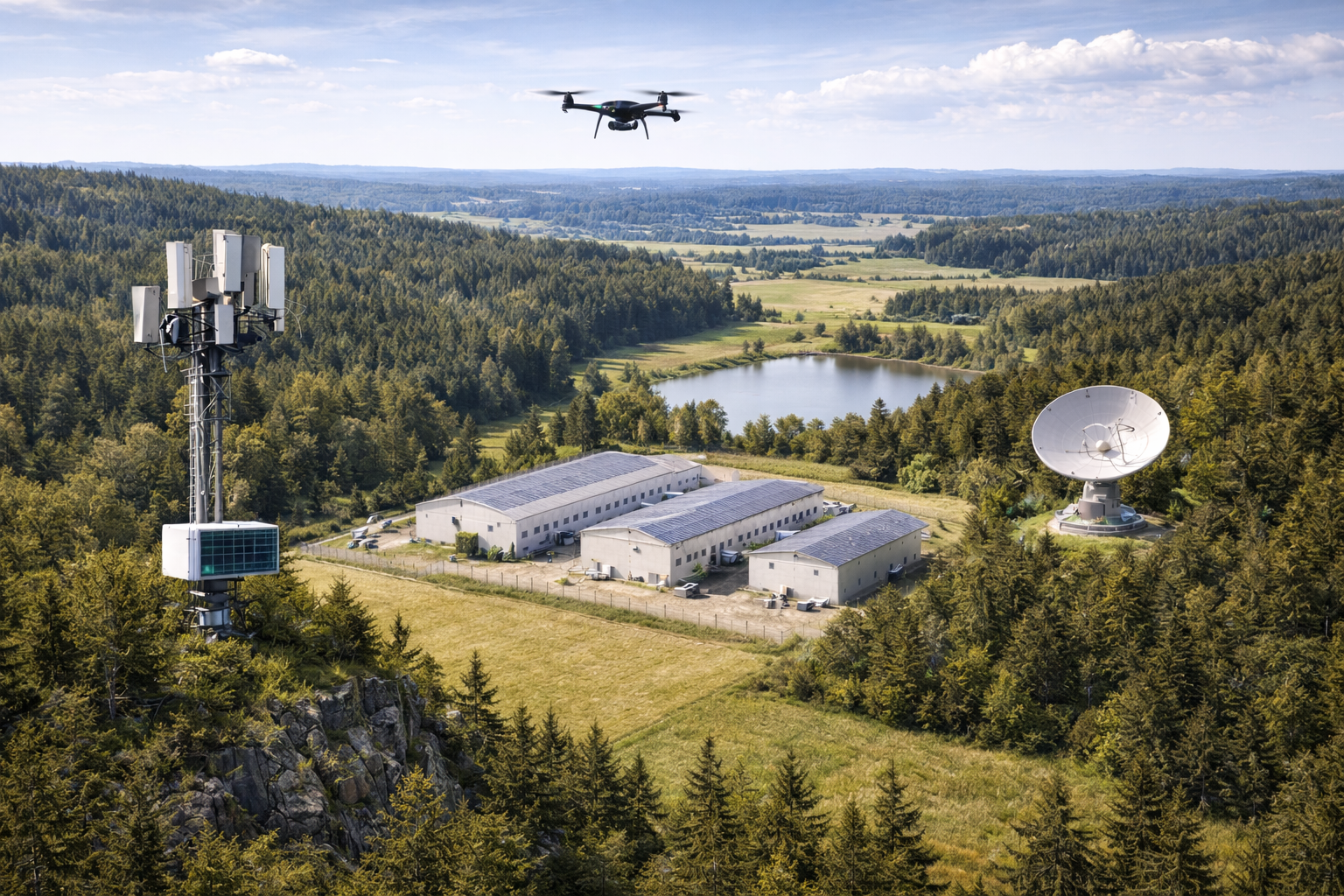
A drone can be small, fast and low flying. It can blend into a busy skyline or appear only briefly before it is already close to a protected area. That is why drone detection is rarely as simple as seeing a drone in the sky.
In practice, a reliable system must answer several questions very quickly. Is it actually a drone or something else. Where is it right now. Where is it heading. And does its behavior suggest an unauthorized or potentially dangerous flight. Detection is only the first step. To be operationally useful, it usually needs to be connected to tracking and identification.
Because no single sensor can answer all of these questions in every environment, modern drone protection systems almost always combine multiple detection methods.
RF detection stands for radio frequency detection. These sensors monitor and analyze radio signals exchanged between a drone and its controller, or other transmissions produced by the drone.
RF detection can provide early warning, sometimes before a drone is close enough to be visually detected. In certain cases, it can help identify the drone type or communication protocol. It may also allow estimation of the pilot’s location, which can be valuable during an incident.
RF detection relies on the drone actively transmitting signals. Autonomous drones flying without a control link, or using non-standard communication methods, may be difficult or impossible to detect this way. In dense urban environments, crowded radio spectra can further complicate analysis and increase uncertainty.
RF detection is well suited for cities, industrial sites and public events where early warning and contextual information are important.
Radar operates by emitting a signal and detecting objects based on reflections. Its main advantage is that it can detect drones even when they are not transmitting any radio signals.
Radar can detect autonomous drones and operates continuously, day and night. It provides stable tracking over larger areas and often serves as the backbone sensor for building a reliable air picture.
Very small drones can be challenging to detect because they reflect only a limited amount of energy. Radar systems may also generate false alarms, particularly in environments with birds or other moving objects. Cost, installation requirements and terrain can further limit deployment options.
Radar is especially effective around airports, critical infrastructure and open areas where continuous wide-area monitoring is required.
Optical systems provide visual confirmation. This includes standard daylight cameras, often referred to as electro-optical or EO, and infrared or IR cameras that detect heat and enable night-time operation.
Optical systems are strong tools for verification. They provide visual evidence that helps operators understand what they are observing. They support classification and identification, reducing uncertainty and lowering the risk of inappropriate responses.
Optical systems depend heavily on visibility. Fog, rain, glare, poor lighting and darkness all reduce performance. Buildings and terrain can obstruct the line of sight. Detection range is limited and strongly influenced by camera placement and field of view.
Optical systems are most effective for confirming detected targets, supporting response decisions and protecting specific sites, especially in urban environments where lines of sight can be managed.
Each detection method has inherent blind spots. RF sensors may miss autonomous drones. Radar can struggle with very small targets or cluttered backgrounds. Optical systems are excellent for confirmation but unreliable as a standalone solution due to changing visibility conditions.
For this reason, best practice relies on a multi-sensor approach. One sensor may provide early detection, another stable tracking, and optical systems may confirm and support identification. Together, these methods reduce false alarms, increase confidence and improve reliability in real-world operations.
Phone
Company
EAGLE.ONE s.r.o., ORG ID: 03947394
Povltavska 5/74, 171 00 Praha 7
